Cargease builds the document checklist for each shipment from its Incoterm, assigns every line to the party who owes it, and tells you which shipments need you today. Your supplier, broker and carrier upload straight to it. Nobody else needs an account.
Working with a small number of design partners on the Mexico–US corridor.

The operations list, filtered to what needs attention today.
You enter the shipment once: mode, direction, Incoterm, route, product. Cargease works out which documents that shipment actually needs and who is responsible for each one.
FOB, DAP, CIF and the rest are not labels here. They determine who clears export, who arranges main carriage, who pays duties, and therefore who owes which document.
Bill of lading, VGM, certificate of origin, pedimento, Carta Porte. Each is assigned to the supplier, broker or carrier who has to produce it, not to a shared folder.
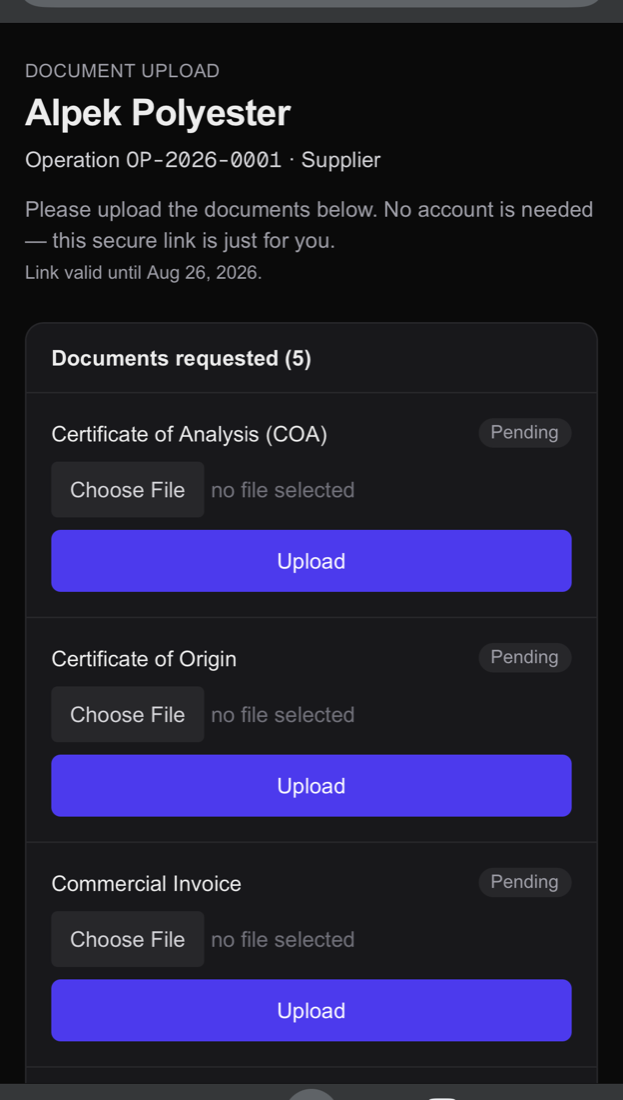
Each party gets a secure link scoped to their own documents on that one shipment. No login, no seat to pay for, nothing to teach them.
A VGM cutoff missed by a day rolls the container. A certificate of origin that arrives late holds the cargo at the border. Cargease reads every deadline on the shipment and says plainly which ones need you.
Shipments with nothing outstanding stay quiet, so the list only speaks when it has something to say.

The reason document portals fail is that they ask the other company to adopt software. This one doesn't. Your supplier gets a link, sees only the documents you asked them for, and uploads.
No account, no password, no training call. The link expires, and it only ever exposes that one party's documents on that one shipment.
Cargease is built for companies that move their own cargo and are judged on what arrives. It is deliberately not for everyone.
Cargease is being built alongside a small number of teams on the Mexico–US corridor, at a founder rate locked in for as long as you stay. If that sounds like your operation, get in touch.
 Cargease